
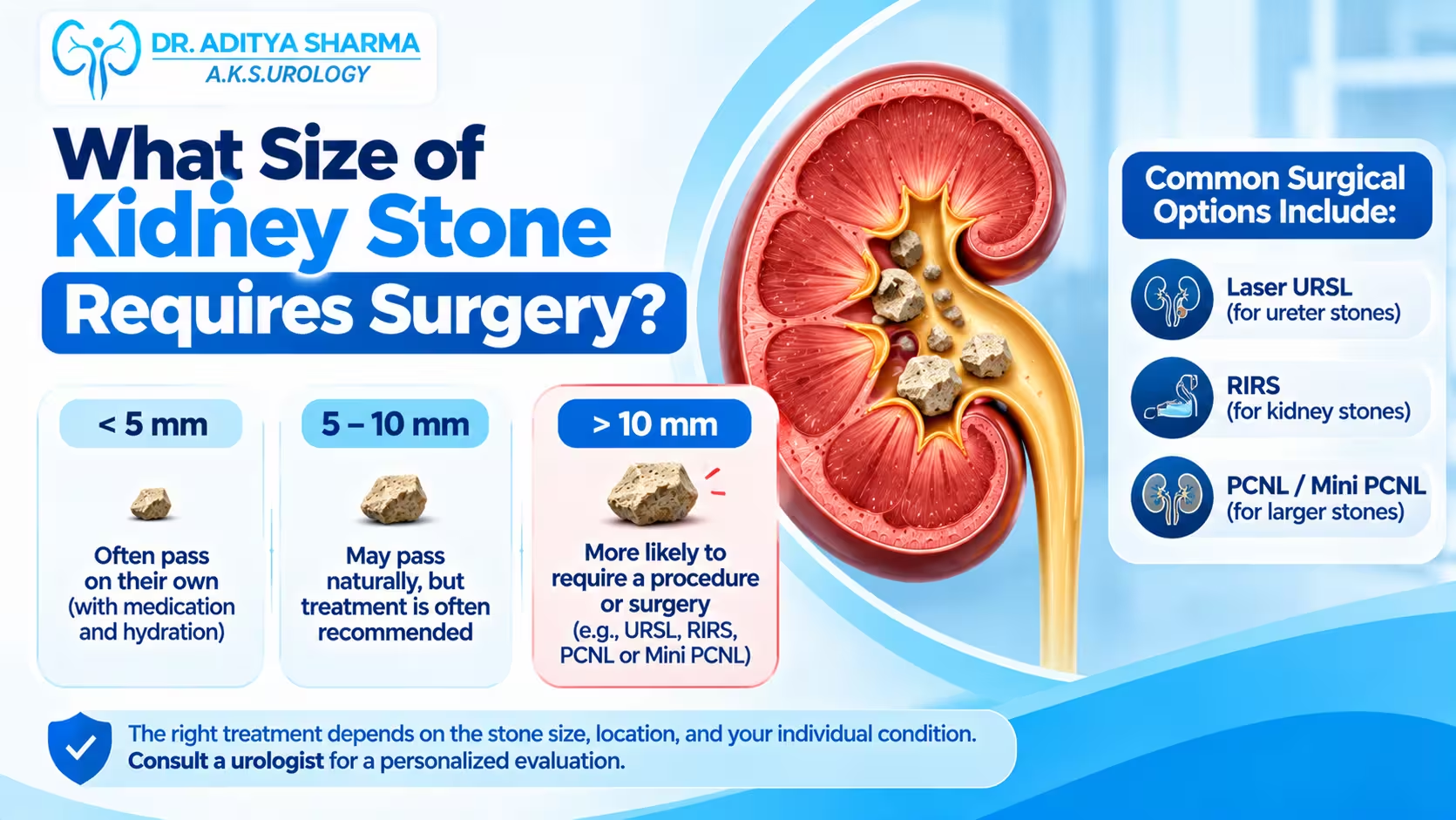
Kidney stones larger than 10 mm (1 cm) almost always require surgery because the chance of them passing naturally is very low.
How Does Kidney Stone Size Affect Treatment?
Kidney stones are measured in millimetres (mm). A 5 mm stone is half a centimetre, while a 10 mm stone is equal to 1 cm.
Small stones can easily pass in the urine. However, the larger the stone, the less possible is its passage through urine as the passage way is narrow due to the size of the ureter, a narrow passage between the kidney and the bladder. The stone can block the flow of urine in this passage.
The position of the stone plays a crucial role. A stone located within the kidney will not lead to any pain, while a stone located in the ureter causes acute pain in the back, flank, or lower abdominal areas.
Kidney Stone Size Chart in mm, Treatment and Risk
The following kidney stone size chart in mm and treatment gives a general idea of how different stone sizes are managed and which size of kidney stone is dangerous.
|
Kidney stone size |
Chance of passing naturally |
Possible treatment |
When can it become dangerous? |
|
Below 4 mm |
High in many cases |
Observation and pain relief |
If it blocks urine or causes infection |
|
4–5 mm |
Good chance, depending on location |
Medicines and follow-up |
If it gets stuck in the ureter |
|
5–6 mm |
Less certain |
Observation or a procedure |
If it causes blockage or repeated pain |
|
6–10 mm |
Lower chance of passing |
SWL or ureteroscopy may be needed |
If urine flow is blocked or kidney function is affected |
|
More than 10 mm |
Unlikely to pass naturally |
Active treatment is usually considered |
If left untreated, it may cause blockage and kidney damage |
|
20 mm or more |
Very unlikely to pass naturally |
PCNL is often preferred |
Higher risk of blockage, infection, and kidney damage if untreated |
Can a 4mm Kidney Stone Pass Naturally?
Yes. The chances of a 4mm kidney stone passing on its own are pretty high. If it is already located in the ureter, it is likely to pass by itself. A 4 mm kidney stone can stay in the kidney and cause no symptoms at all.
If the kidney stone does not grow and does not block the urine, the doctor will recommend performing routine scans but not treating it right away. If there is pain, painkillers will be prescribed. Sometimes medication that relaxes the ureter is prescribed as well.
A 4 mm stone in the kidney needs to be seen by a doctor anyway. If the pain stops, it does not mean that the stone has passed.
Does a 6 mm or 7 mm Kidney Stone Need Surgery?
The probability that a 6mm or 7mm stone passes naturally is less compared to a stone of a smaller size. Some 6mm or 7mm stones can also pass naturally, depending on where they are located.
Nonsurgical treatments for 6mm kidney stones involve pain control, drugs, and continued observation. In certain cases, the doctor might give you an alpha-blocker to loosen up your ureter so the stone can move out.
In the same way, it is possible to treat 7mm kidney stones nonsurgically when there is no infection, no blockage, and no harm to the kidney. If the stone does not move or causes frequent pain, you will need a procedure.
Does a 10 mm or 14 mm Kidney Stone Require Surgery?
10 mm stone equals 1 cm. Such a size does not have the natural ability to pass through the ureter, and the surgeon may advise further action if the stone causes trouble.
The question, "Is a 10 mm stone in the kidney dangerous? " has an answer: it depends on the case. This stone inside the kidney, not causing pain or obstruction, can be followed up in selective cases. But it will hardly be expelled by itself and will require planned intervention.
Also, a 14 mm stone in kidney will be difficult to expel by itself. According to its location and hardness, the surgeon can choose laser treatment or shock wave therapy.
1.7 cm stone means that the stone is 17 mm. It is regarded as a large one and requires intervention instead of waiting for it to pass.
Which Kidney Stone Size Is Dangerous?
There is no single size that makes every kidney stone dangerous. Even a small stone can cause serious trouble if it blocks urine flow and leads to an infection. A larger stone may cause damage if it remains untreated and affects kidney drainage.
Medical attention is needed if a patient has:
- Fever or chills along with kidney stone pain.
- Severe pain that does not improve with medicine.
- Repeated vomiting.
- Difficulty passing urine or very little urine.
- Signs of reduced kidney function.
An infected kidney with blocked urine flow is a medical emergency. People with only one working kidney also need urgent attention if a stone causes a blockage.
Which Procedures Are Used to Remove Kidney Stones?
The treatment method is decided by the urologist after assessing the size, location, hardness, and effect of the stone on kidney functioning.
1. Shock Wave Lithotripsy (SWL or ESWL): Sound waves are produced outside the body and concentrated to shatter the stone into tiny fragments that can pass out in the urine. This might be suitable for certain small-to-medium-sized stones, but repeated sessions could be needed for certain patients.
2. Ureteroscopy (URS): The endoscope is inserted through the ureter, and the stone is reached in the ureter. The stone is shattered using the laser. In some cases, a temporary DJ stent is inserted for the drainage of urine.
3. Retrograde Intrarenal Surgery (RIRS): An endoscope is inserted through the natural urinary passage and advanced to the kidney. A laser is used by the urologist to shatter the stone. RIRS is often used for selected stones in the kidney.
What Tests Are Needed Before Kidney Stone Surgery?
The urologist has to be aware of the exact stone size and location before recommending treatment. Tests that may be recommended include the following:
- Ultrasound: Identifies the presence of stones and fluid buildup due to urine obstruction.
- CT KUB: Provides more details regarding the size, number, and location of the stone.
- Urine test: Detects blood and infections.
- Blood test: Useful in determining kidney function and infections.
In case a stone is extracted, it can also be analyzed to determine its composition.
What Is Recovery Like After Kidney Stone Surgery?
The recovery process will depend on the type of treatment undergone. Following ESWL, one may feel a little pain or notice blood in the urine due to the presence of tiny fragments that are being passed out through the urine. For cases that have undergone URS or RIRS, there may be pain while urinating.
A recovery period following PCNL may be relatively long compared to other treatments since PCNL entails an opening at the back of the body.
Scans taken in follow-up sessions can be used to see if the stone has been removed and if there is any normal flow of urine.
Why Choose Dr. Aditya K. Sharma for Kidney Stone Treatment in Lucknow?
Dr. Aditya K. Sharma, Urologist in Lucknow, Urologist & Kidney Transplant Specialist, provides evaluation and treatment for kidney stones and other urological conditions.
Kidney stone treatment requires careful assessment of the stone's size, location, density and effect on kidney function. Depending on the clinical findings, treatment may involve observation, medical management or procedures such as RIRS, Laser URSL, PCNL, Mini PCNL, Mini Perc and Supine PCNL.
A proper evaluation helps determine the most appropriate treatment approach rather than recommending surgery based on stone size alone.
Patients experiencing recurring kidney stones, severe pain, urinary obstruction or other stone-related symptoms can consult Dr. Aditya K. Sharma for further evaluation.
Related Treatments
- RIRS Surgery
- Laser URSL Surgery
- PCNL Surgery
- Mini PCNL Surgery
- Mini Perc Surgery
- Supine PCNL Surgery
Conclusion
The size of the stone is very important for the doctor in deciding the treatment modality needed for the patient. Small stones are normally excreted through urine, whereas bigger ones need surgery. However, even a small stone can cause major complications if it blocks the flow of urine or causes infection. The results of the scan, symptoms, and condition of the kidneys become important when deciding on the treatment options. Please contact Dr. Adittya K. Sharma, one of the best urologists in Lucknow, with more than 20 years of experience
Frequently Asked Questions
1. How many millimeters are the average size of kidney stones?
There is no average size for a kidney stone. They can vary from under 4 mm up to much larger sizes. The smaller kidney stones have a better possibility to pass out naturally, while the bigger ones require treatment.
2. Can a 4 mm kidney stone pass without surgery?
Yes, they do. Some kidney stones of 4 mm pass naturally in the urine without surgery. However, it depends on their location and obstruction.
3. Is it possible to treat a 6 mm kidney stone without surgery?
Yes, in some cases, 6 mm kidney stone treatment without surgery is possible. Medications and observation are effective in cases without severe obstruction or infection. In case of obstruction, surgery will be required.
4. Is it possible that a 7mm kidney stone passes without surgery?
Sometimes 7 mm kidney stone treatment without surgery is possible; however, the chances are lower in comparison with small stones. The doctor may recommend taking medications and observing periodically.
5. Is a 10 mm kidney stone dangerous?
This size of kidney stone does not pass spontaneously; however, it does not mean that it is dangerous. There are other factors to be considered.
6. Is there a necessity for surgery to remove a 14 mm kidney stone?
Generally, a 14 mm stone requires treatment, as they rarely pass spontaneously. The treatment can include RIRS, ESWL, and some other procedures.
7. Is a 1.7 cm kidney stone big?
Yes. A 1.7 cm kidney stone measures 17 mm. It is considered large and usually needs a procedure to remove it.